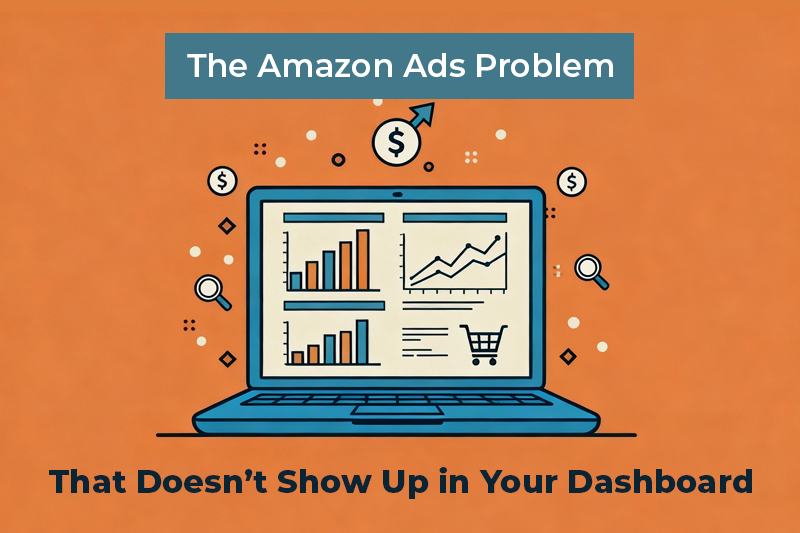
Most sellers notice the same tension at a certain stage.
Campaigns are live.
Keywords are converting.
Spend is moving.
Yet growth feels just out of reach.
This isn’t an execution problem.
It’s not a bidding mistake.
And it’s rarely caused by competition alone.
So what’s happening?
Your ads are competing internally for the same demand, and the auction is charging you for it.
How Internal Competition Creeps Into Healthy Accounts
Internal competition doesn’t show up because an account is mismanaged.
It shows up because the account has grown.
Over time, structure expands to capture more intent:
- New match types are added
- New ad formats are layered in
- Auto campaigns stay live longer than intended
Eventually, multiple campaigns become eligible for the same search.
From the outside, everything looks productive.
Underneath, auctions get more expensive, and performance signals blur.
This is not wasted spend from bad traffic.
It is inflated spend from overlapping intent.
What This Looks Like in Real Seller Operations
Across mature Amazon ad accounts, the pattern is consistent:
- Exact, phrase, and broad campaigns triggering on the same search
- Sponsored Products and Sponsored Brands competing for the same shopper
- Auto campaigns continuing to spend on proven terms
- Strong keywords converting, but at higher costs than expected
Nothing is broken.
Nothing flags red.
The account is active.
The structure is just crowded.
Why Amazon Charges More When Ads Overlap
Amazon does not reward structure.
It rewards auctions.
When multiple ads from the same account are eligible for the same query, Amazon does not consolidate them.
It lets them compete.
That competition raises clearing prices.
The result:
- CPCs rise without incremental volume
- Performance blends across campaigns
- True winners become harder to identify
- Scaling feels expensive instead of efficient
This is why accounts can look optimized while quietly losing leverage.
👉 This is one of the structural pressure points we examine during strategic ad reviews.
Busy Work vs. Outcome Movement
This is where teams often drift.
Busy work looks like
- Adjusting bids to chase rising CPCs
- Launching new keywords to offset flattening results
- Layering campaigns to regain momentum
Outcome movement looks like
- Reducing overlap before increasing spend
- Assigning ownership to proven demand
- Using structure to reveal what’s working instead of masking it
One adds activity.
The other restores efficiency.
The Structural Fix Most Sellers Skip
Before touching bids or budgets, we look for internal competition.
Here’s how experienced operators approach it.
Establish Clear Keyword Ownership
High-intent terms should have a single job.
That means:
- One campaign responsible for capture
- One match type aligned to intent
- One purpose tied to outcome
Exact handles capture.
Phrase supports controlled expansion.
Broad discovers new demand.
Everything else steps aside.
Treat Auto as Discovery, Not a Safety Net

Auto campaigns are valuable when they surface new converting terms.
They become expensive when they keep spending on proven ones.
Once a term converts consistently and lives in manual structure, auto should hand it off.
If it doesn’t:
- Control weakens
- CPCs inflate
- Manual performance lags
This does not mean auto campaigns are bad.
It means they should exit when their job is done.
Separate Brand Defense From Growth
Brand terms mixed into category campaigns create confusion.
They:
- Inflate blended CPCs
- Mask true efficiency
- Blur performance signals
Clean separation restores clarity.
Brand defense protects position.
Category campaigns drive growth.
Each serves a different purpose and deserves its own structure.
Watch Where Auctions Are Won
Overlap is not limited to keywords.
Placement competition matters.
When the same term triggers across Top of Search and other placements in multiple campaigns, cost rises without benefit.
Strong campaigns earn priority.
Support campaigns should live in cheaper inventory.
This restores efficiency without reducing coverage.
What Changes When Structure Is Clean

When internal competition is removed, sellers notice the shift quickly.
- CPCs stabilize
- Spend becomes predictable
- Revenue begins moving without bid pressure
Decisions get easier to defend internally.
Performance feels intentional instead of fragile.
Most importantly, ads stop feeling busy and start feeling effective.
The System Behind the Fix
We address this problem using the same system we apply across every partnership.
Deep Understanding
We pressure-test where growth is being lost, not where activity is happening.
Outcome-Driven Strategy
Structure is aligned to intent, ownership is clear, and tradeoffs are explicit.
Proven Process & Partnership
Overlap is monitored, not explained away. Adjustments are proactive, not reactive.
This isn’t a tactic.
It’s a way of running ads with control.
Reset the Frame
Activity is not progress.
Efficiency is not scale.
Reporting is not ownership.
If your Amazon ads look healthy but momentum is gone, the issue is rarely execution.
It’s structure.
The good news is structure is fixable.
Pressure-Test Your Ad Strategy

If you’re spending $5,000 or more per month on Amazon Ads and growth feels harder than it should, clarity is the fastest path forward.
Our 7-Day Ads Sprint is built to uncover where internal competition is inflating costs and how to reclaim margin without increasing risk.
In one focused week, we:
- Identify where campaigns are competing internally
- Isolate demand that needs ownership
- Deliver a clear, prioritized plan for efficiency and scale
No generic audits.
No surface fixes.
Just a pressure test of your ad structure.